
AI Automation Is Not "One and Done"
One of the biggest misconceptions about AI automation is that you build it once, turn it on, and move on. That almost never happens in real businesses.
One of the biggest misconceptions about AI automation is that you build it once, turn it on, and move on. That almost never happens in real businesses. A lot of hate workflow systems (rightfully) get is that they are too brittle, easy to break, and require lots of maintenance. If you don't plan for it, the breaks will feel unexpected even when they shouldn't be.
In practice, automation behaves much more like a living system. It starts with a model of how work should happen, then it meets reality, and reality always has edge cases. If you are serious about ROI, you should assume from day one that the first version is only the beginning.
Every Workflow Starts With an Incomplete Map
When teams design a workflow, such as expense approvals, claims processing, lead qualification, or onboarding, they begin with the best understanding they have at that moment. They capture who approves what, which fields are required, which thresholds matter, and which systems are involved. On paper, it looks complete. In production, it is not. No team can fully anticipate how messy real data and real behavior will be. Unexpected values show up, unusual vendors appear, special exceptions get requested, fields are left blank, and rules conflict. This is not a failure of planning. It is the natural result of running a system inside a real organization.
The First Version Is Always a Prototype
The first version of any automation is never final. It is a hypothesis: we think this is how our process works. Once it runs in the wild, that hypothesis gets tested immediately. Within weeks, cracks appear. Within one to two months, most teams uncover scenarios they never considered, approvals that do not fit the original logic, data formats that break assumptions, new compliance rules, new pricing structures, new vendors, and entirely new edge cases.
This is where most projects quietly diverge. Some teams treat this feedback as fuel for improvement. Others treat it as evidence that automation is "not ready yet" and move on. Only the first group ever sees serious returns.
The problem is not that edge cases appear. The problem is that most teams underestimate how much focused time and iteration is required before a workflow becomes stable enough to deserve trust.
Example: Expense Approvals
Consider a simple expense approval workflow. Under $500 goes to a manager. Over $500 goes to finance. A category is required. A receipt is required. On day one, this looks reasonable. Then reality happens. Someone submits a multi-currency expense, a shared team subscription, a reimbursable travel package, a vendor that does not issue receipts, a partial refund, or a personal and business split charge. Suddenly, the simple flow is no longer enough.
So the team patches it. A rule is added. A condition is introduced. An exception is created. Then another edge case appears. Then another. What looked complete in a design document turns out to be a rough draft of how the business actually behaves.
If the team stops here and declares the project done, the automation will keep breaking. People will lose confidence. They will route complex cases around it. Manual handling will quietly return. On paper, the system exists. In reality, it is not in production.
AI Makes Change Easier, But Only With Real Commitment
AI changes something important in this process. Traditionally, every new exception meant writing logic, deploying changes, and waiting for engineering. That friction slowed improvement. With AI-assisted automation, domain experts can participate directly in refining workflows and encoding business judgment.
Tooling matters, but commitment matters more. You need visibility, editable logic, safe testing, versioning, and human-in-the-loop controls. More importantly, you need a team willing to spend weeks and months refining the workflow until it consistently replaces the manual process it was meant to eliminate.
But this only matters if the organization commits time to the system. Someone has to review failures. Someone has to study patterns. Someone has to decide which exceptions deserve permanent rules. Without that discipline, AI only makes it easier to launch a weak first version faster.
Automation Requires Both Business Logic and Robust Technology
Most teams misdiagnose where complexity lives. They assume the hard part is the integrations, or they assume the hard part is the business rules. In reality, you need both. Yes, most of the day-to-day breakage comes from business logic: who decides this, when do we override the rule, what risk is acceptable, what counts as a valid exception, and when do we escalate. But that logic only survives if the underlying platform can express it reliably, observe it in production, and change it safely.
This is where a lot of projects fail. The organization learns what the real rules are only after the workflow runs, but the technology cannot adapt fast enough. Or changes require engineering cycles, redeployments, and risk. Or there is no testing and no versioning, so every fix introduces new breakage. The result is predictable: the automation keeps breaking, people stop trusting it, and it never becomes the default path.
The goal is not just to encode business decisions. The goal is to do it on a platform that makes iteration cheap and safe, and with a process that gives someone ownership to keep refining it. That can be a skilled operator making the changes, or AI that can propose changes, apply them, and validate them with guardrails. Either way, sustained iteration on top of a robust platform is what turns early prototypes into workflows that generate meaningful ROI and genuinely replace manual work.
Why "Set and Forget" Fails
Most failed automation projects do not fail dramatically. They fade. The workflow still runs, but people bypass it. Data quality drops. Exceptions are handled in spreadsheets and chat threads. Gradually, the system is labeled unreliable.
In most cases, the idea was sound. What was missing was sustained investment. Teams expected immediate payoff. When early friction appeared, patience ran out. The automation never reached the maturity required to justify itself.
Trust is not created at launch. It is earned through consistent performance over time.
How Squig Approaches This
At Squig, we treat automation as an evolving representation of how your business actually thinks and decides. With Squig DFY (done-for-you), a business integration expert works with you to map workflows, capture decision logic, and encode operational policies.
Then we stay engaged. As the workflow runs, we analyze where it breaks, where exceptions cluster, and where people override outcomes. Each signal feeds the next iteration. We refine until the system reflects reality, not just the initial assumptions.
This deliberate process is what turns experiments into infrastructure. Over time, automation stops being a fragile layer and becomes a dependable operational backbone.
Automation Is a Process, Not a Project
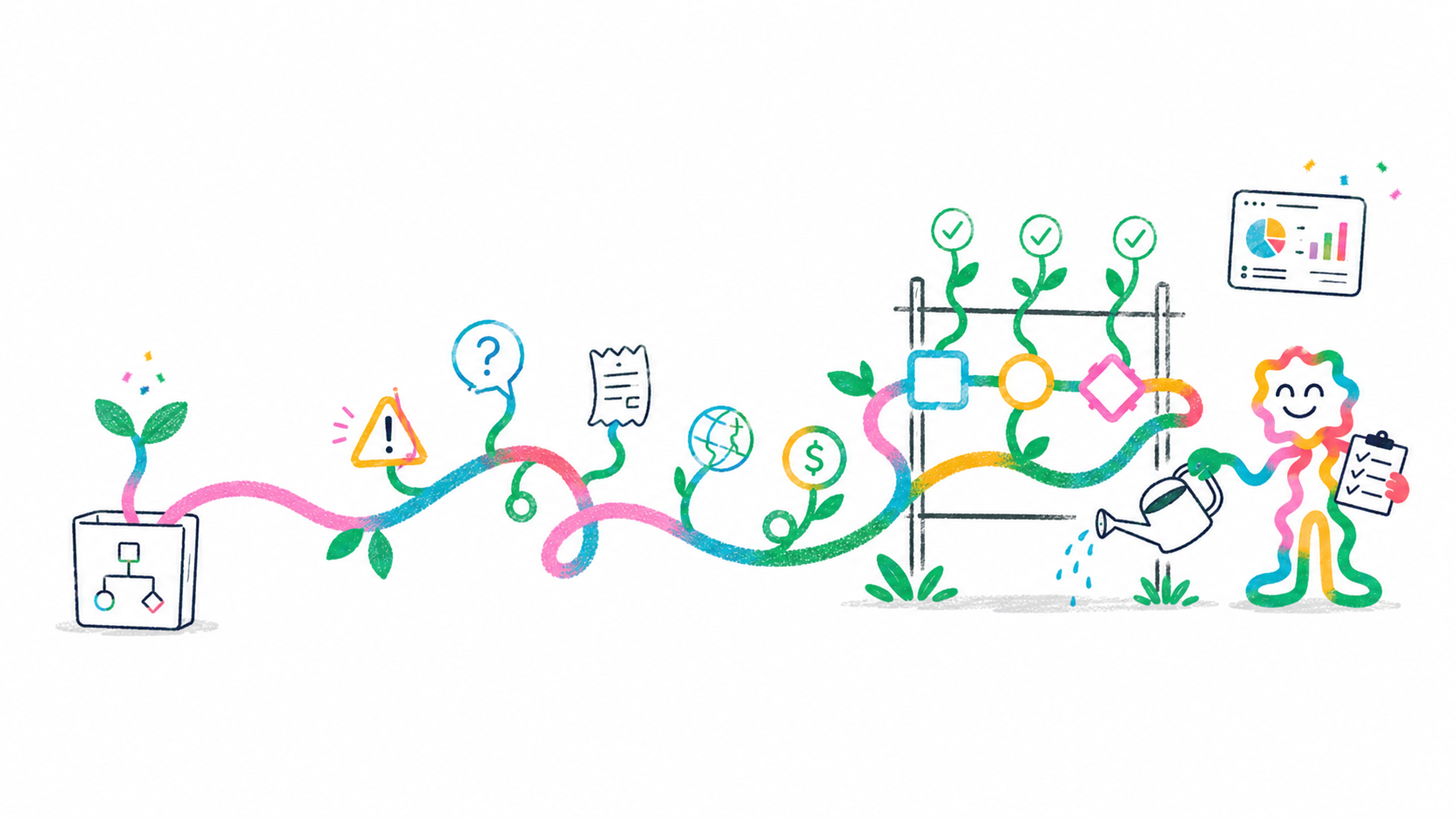
AI automation is not something you install and move on from. It is something you cultivate. You start with a model, let reality challenge it, adapt, refine, and repeat. You invest long enough for the workflow to absorb edge cases, encode judgment, and consistently outperform manual handling.
That is when ROI becomes obvious. That is when people rely on it. That is when it truly goes into production.
If you are serious about automation, the question is not whether AI can build it quickly. The question is whether you are willing to stay with the problem long enough for the system to become genuinely valuable.
With Squig DFY, we partner with teams through that entire maturation cycle. Not just to launch workflows, but to turn them into durable, trusted systems that compound in value over time.